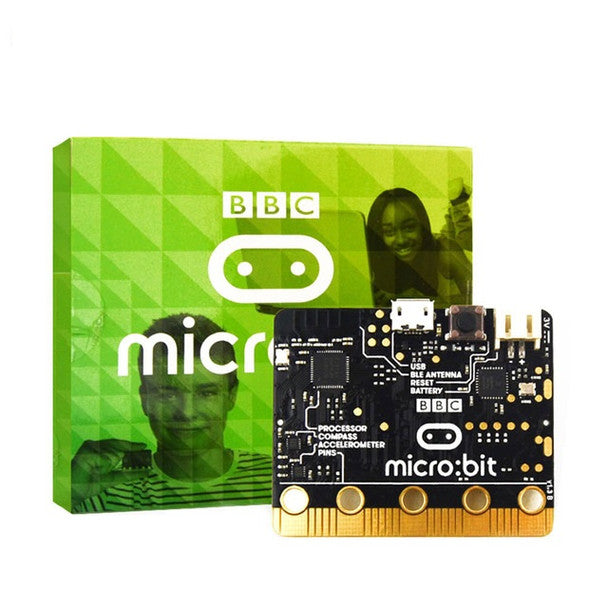
BBC micro:bit Bluetooth 16kB RAM 256kB
BBC micro:bit Bluetooth 16kB RAM 256kB
Product features
Product features
Pocket-Sized STEM Microcomputer: Compact 4cm x 5cm board designed to teach programming, hardware interaction, and electronics to students and hobbyists alike.
Nordic nRF51822 SoC Architecture: Powered by a 32-bit ARM Cortex-M0 processor running at 16MHz with 16KB RAM and 256KB flash memory for hosting user code and scripts.
Wireless Bluetooth Low Energy (BLE) & 2.4GHz Radio: Built-in Bluetooth 4.0 connectivity enables wireless communication with smartphones, tablets, and other micro:bit boards.
Interactive 5 x 5 LED Matrix & Tactile Buttons: Features 25 individually addressable red LEDs for displaying text, patterns, and animations, plus 2 user-programmable push buttons.
Onboard Motion & Compass Sensors: Integrated 3-axis accelerometer for gesture/motion sensing and a 3-axis magnetometer (digital compass) for orientation detection.
Materials and care
Materials and care
Module Construction: Built on a multi-layer FR-4 glass epoxy printed circuit board featuring surface-mount components, edge connector pads, and standard micro-USB header.
Operating Voltage & Logic: Operates logic circuitry on 3.3V DC. Power via the Micro-USB port or external JST battery connector (3V DC).
Handling Precautions: Handle carefully by the outer board edges. Practice standard electrostatic discharge (ESD) precautions to protect delicate onboard integrated circuits.
Environmental Limits: Operating temperature range spans 0°C to +70°C. Keep protected from static discharge, metallic dust, and liquid moisture.
Merchandising tips
Merchandising tips
Essential Foundation for Coding Education: Position as the definitive starter board for school classrooms, STEM workshops, and beginners learning MakeCode, Python, or Scratch.
Versatile Portable Hardware Platform: Highlight its low power footprint and built-in sensors, making it ideal for mobile wearable projects, smart badges, and wireless data loggers.
Recommended Cross-Sell Add-ons: Pair with Micro:bit Protective Silicone Cases, Expansion Breakout Boards, Edge Connector Breakouts, and Micro-USB Cables.
Zero-Breadboard Prototyping: Emphasize that beginners can immediately create games, animations, and simple sensors straight out of the box without extra electronic components.
Couldn't load pickup availability
Share